Technology · Explanatory guide
New website, an application, or a process improvement: how to decide
A website, a custom application and a process change solve different problems. Find the constraint first, then choose the smallest fix that removes it.
Diagnose the constraint first
A new website, a custom application and a process improvement are all answers. The useful question comes before them: what is limiting the business right now?
A constraint is the one step that holds back everything after it. Fixing anything else changes little. The symptoms usually point to one of three places:
- People cannot find, understand or trust the business online. That points to the website.
- Staff or customers repeat a rule-based task by hand, and the tools in use cannot do it. That points to an application.
- Work is dropped, duplicated or delayed because steps are unclear or nobody owns them. That points to process.
Four questions help locate it:
- Where does work wait?
- What do customers complain about most often?
- What do staff re-enter, copy or chase every week?
- Which number would change if this were fixed?
When a new website is the right answer
A website is the right investment when the site itself stops people from doing what they came to do.
Signs include visitors who cannot find services, prices or contact details, pages that are slow or unstable on a phone, a platform the team cannot update, and content that no longer matches what the business sells. Nielsen Norman Group's introduction to usability describes usability as a measure of how easy an interface is to use, and makes the point that people leave websites they find difficult. Google's Web Vitals guidance sets out the quality signals it considers essential to a good experience, covering loading, interactivity and visual stability.
A rebuild is the wrong answer when the site receives few visitors, which is a visibility problem, or when inquiries arrive and go unanswered, which is a process problem. Sometimes repair is enough to begin with. The published case study for A1 Party Rentals describes a website virus and a disabled Google Ads campaign being fixed before work on a new website began.
Design does not replace substance, either. Google's guidance on helpful, people-first content asks whether content is created primarily for people. A redesigned site carrying the same thin pages will have the same weakness.
When an application is the right answer
A custom application earns its cost when a task is frequent, follows clear rules, involves several people, and has outgrown email, spreadsheets and off-the-shelf software.
The published case study for the Uptown Med Spa Franchise Ordering Portal describes that pattern. Franchise owners needed a simpler way to order from corporate, and the answer was a purpose-built ordering portal with a five-step order flow and corporate approval.
Two checks come before any build.
First, look for an existing product. If a booking system, a form tool or an accounting add-on already does the job, configuring it will almost always be quicker than building.
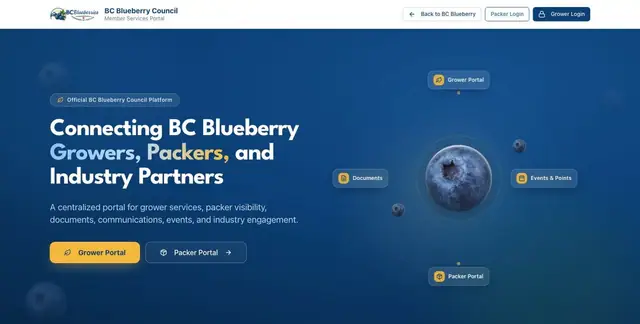
Second, check the records the application will rely on. The published case study for the BC Blueberry Grower Portal describes the grower database being corrected first, and the portal being built afterwards.
An application is the wrong answer when the process behind it is still undefined. Software will encode the confusion and make it harder to change.
When a process improvement is the right answer
If the problem is who does what, in which order, and what happens at each handoff, start with process. It is the least expensive option to test and the quickest to reverse.
Common signs:
- The same question gets asked twice.
- Tasks live in text messages and memory.
- Results depend on who is working that day.
- Nobody can say how many requests are open.
A fix can be modest: a named owner, a checklist, one shared place for requests, a weekly review. Run it for a month and see what changes.
A process fix can also reveal that a tool is needed. The published case study for AIOMP Hub describes requests arriving by text, call and email, with some slipping through. The agency built the hub, and requests now convert into owned tasks. The rule came first: every request has an owner. The tool enforces it. A written process is also the best specification a developer can receive.
The cost of building the wrong thing
The obvious cost is money and months. The less obvious costs last longer.
- The original problem remains, and now there is something new to maintain.
- A new website placed in front of a weak follow-up process produces more unanswered inquiries.
- An application built on inaccurate records gives wrong answers faster.
- A tidy internal process does little if customers cannot load the site on a phone.
- Staff who have lived through one failed project are slower to adopt the next change.
Each of these comes from choosing the solution before stating the problem.
A simple decision sequence
- Write the problem in one sentence without naming a solution.
- Find where it occurs: before the inquiry, at the inquiry, or in delivery and administration.
- Ask whether changing who does what, and when, would fix it. If so, do that first and run it for a month.
- If the process is clear but slow or error-prone by hand, look for an existing tool.
- If nothing fits and the task is frequent and valuable, scope a custom application, starting with the smallest useful version.
- If customers cannot find, use or trust the website, repair what can be repaired. Rebuild when repair cannot solve it.
- Choose one number that will show whether it worked, and measure it before and after.
The order matters. Process changes are quick to test, existing tools are quick to trial, and custom work is the hardest to undo. Starting with the lightest option that could solve the problem keeps the larger options available, with better information, if they turn out to be needed.